Program
Franz Schubert
String Quintet in C Major, Op. 163, D. 956
The Euclid Quartet with cellist Adrian Daurov
Now in its 27th season, Euclid is the Resident String Quartet at Indiana University South Bend. To date they have released six albums earning a review from Gramaphone that stated “stunning…their command is exhilarating in its silken breadth and sleek virtuosity.” The Euclid will be joined by the renowned cellist, Adrian Daurov.
Program Notes
Franz Schubert (1797-1828)
String Quintet in C Major, Op. 163, D. 956 (1828)
Performance time: 53’
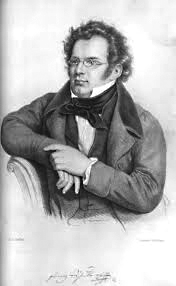
Franz Schubert
In 1828, Thirty-one year old Schubert died; Webster published American Dictionary of the English Language; French author Jules Verne born..
Our work today is Schubert’s last chamber work before his untimely death at age 31. In those brief thirty-one years he wrote nine symphonies, twenty string quartets, two piano trios, several other significant chamber works (including the String and “Trout” Quintets), numerous operas, twenty-one piano sonatas, other piano works including the F minor Fantasy for four hands, and of course his vast catalogue of over six hundred songs.
He accomplished all of this despite ill health, financial troubles and depression. He served as torchbearer at Beethoven’s funeral the year before he himself died, and in 1888 the bodies of both Beethoven and Schubert were exhumed and placed side by side in Vienna’s Central Cemetery.
“Music lovers are in general accord that Schubert’s (String) Quintet is the greatest work in the chamber music repertoire. …Pianist Arthur Rubinstein asked that the slow movement be played at his funeral, and violinist Joseph Saunders had the second theme of the first movement engraved on his tombstone. Through the loftiness of its conception, the spiritual quality of its melodies, and the masterfulness of its technique, the Quintet touches listeners in a very special and personal way.” —Melvin Berger
“For the lover of chamber music, Schubert’s String Quintet emerges as one of the purest, one of the most ideal expressions of mankind’s rich and varied emotional world. Musician and amateur alike seem to agree that art has never been more successfully wedded with musical technique than in this completely satisfying composition.” —Martin Chusid
These tributes are responding to the ethereally beautiful melodies and wide range of emotion in this work. It is interesting to think about why Schubert chose to add a cello to the standard string quartet rather than choosing the more customary viola, as was done by Mozart and Beethoven. Schubert himself answers this by exploring the sonorities and wide tonal range of the cello, as we hear in his ever-changing pairings and combinations of instruments throughout the Quintet. This unusual instrumental combination allows one cello to share fully the thematic material, often in octaves with the first violin, to create consistently strong melodic lines. At times a nearly orchestral effect is achieved.
Indeed, the length and breadth of this entire work are symphonic in proportion. The first movement alone is almost as long as many an entire early classical symphony, and longer than the first movement of any of Beethoven’s symphonies. And the intensity, passion and wide mood swings combined with propelling rhythmic drive are unusual for a work in the so-called “Classical Period” of the Western canon—one doesn’t find similar inspiration until the late Romantics such as Mahler.
The Quintet opens with a simple C major chord which swells from very soft to very loud. This theme is then restated in D minor, an unusual harmonic movement that lets us know that an unusual harmonic journey is ahead. The second theme, a beautiful duet for the two cellos, is the emotional climax of the movement.
The Adagio’s principal theme is of ethereal lyricism and suspension. Plucked notes in the second cello provide rhythmic structure. The second theme of this movement combines the first violin and first cello in unison while the other three instruments provide accompaniment.
The third movement opens as a lively rustic dance in triple meter, with melodic figures reminiscent of horn calls adding to the orchestral feeling of the work. This exuberant music continues until the Trio, which suddenly turns profoundly introspective, as if the composer is suddenly reminded of his own ominous fate amid the grand noise of life. There is then a return to the lively music that opened the movement.
The light-hearted final movement develops two themes: the one, a Hungarian folk dance and the other, some Viennese café music. Toward the movement’s conclusion, the two cellos sing a sweet duet accompanied by the viola, as a reference to the second theme of the first movement. The tempo then picks up, and the Quintet concludes with a brilliant, exciting finish.
Schubert composed the Quintet in August and September 1828, and completed it just weeks before his death in November. In a letter dated October 2, he offered it to a publisher, who refused. Its premiere did not occur until 1850; it was published three years later.
For a marvelous recording of this work, please enjoy this one from 1952 that features Isaac Stern, Alexander Schneider, Milton Katims, Pablo Casals, and Paul
Tortelier.
Program Notes by Louise K. Smith
with thanks to Lucy Miller Murray, Melvin Berger,
Martin Chusid, Nancy Monsman and Joseph Way
It is with these notes that I say goodbye as CCMS’s program notes writer. It has been eight fascinating, wonderful seasons, which I have enjoyed immensely. I thank you most sincerely for giving me the opportunity to explore this marvelous repertoire with you.
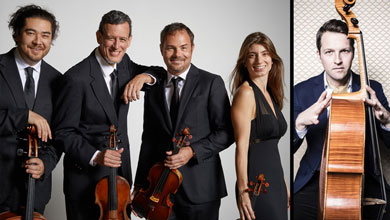
The Euclid Quartet with cellist Adrian Daurov
Subscribe
Today!
Individual tickets may be purchased at the door (cash or check only) immediately before each concert.
All concerts are held at a private club just off Michigan Avenue in Chicago.
Call or email for more information
815-314-0681
office@ChicagoChamberMusicSociety.org