Program
Haydn
String Quartet in C Major, Op. 20, No. 2, “Sun”
Mozart
String Quartet No. 21 in D Major, “Prussian,” No. 1 “The Violet”
Mendelssohn
Capriccio for String Quartet in E minor, Op. 81, No. 3
Viano Quartet
Praised for their “virtuosity, visceral expression, and rare unity of intention” (Boston Globe), the Viano Quartet has quickly soared to international acclaim. They are currently Bowers Program Artists at the Chamber Music Society of Lincoln Center.
Program Notes
Franz Joseph Haydn (1732-1809)
Piano Trio No. 1 in C minor, Op. 8 (1923)
Performance time: 23’
Haydn’s six quartets, Op. 20, are widely known as the “Sun” quartets, in reference to an illustration of a rising sun that appeared on an early edition. The nickname is a nice bit of accidental poetry, as these quartets mark the dawn of the string quartet in history. Haydn’s “Sun” quartets showed the possibilities of the ensemble in their vast expressive range, stylistic diversity, and seemingly endless play of instrumental textures. They would be studied by countless composers then and after, including a young Mozart. The second of the six, in C major, is especially remarkable for its capacious emotional extremes and references to other musical forms, embracing fugue, folk dance, and opera.
Suggested recording: Isidore String Quartet, 2022
Haydn opens the quartet with a wonderful musical joke. The opening melody is staid and stately, but the parts appear to have been completely jumbled. Cello takes the high melody, the second violin plays in the middle, and viola provides a bass line (00:25 in the video). The sound is rich, distinctive, and utterly wrong. When the first violin enters with the melody, the instruments begin to behave, but this moment of levity lingers over the quartet. As the movement continues, Haydn’s music displays a deep sense of dialogue between all four instruments. This intricate complexity in the texture made these quartets radical when they first appeared and would be deeply influential for future composers.
Haydn describes his slow movement as a capriccio, denoting a piece that does not conform to any preexisting form. This movement draws extensively and imaginatively from opera. The stern octaves that open the movement evoke orchestral strings (5:34), and dotted, march-like rhythms suggest brass and drums (8:03). The atmosphere is somber and mournful, but undergoes a stunning transformation in the movement’s second half: the music switches to a major key and the first violin plays a long, soaring melody marked cantabile (singing) over undulating accompaniment from the rest of the quartet (9:12). After the darkness of the minor mode, the turn to C major sounds as a shaft of sunlight in this “Sun” quartet.
Many of Haydn’s minuets are highly stylized folk dances, and Op. 20, No. 2’s third movement is no exception. The sustained notes and lilting triple meter evoke country fiddling. Especially characteristic of folk style is the way the melody occasionally slips into subtle dissonance with the accompaniment, suggesting a slight looseness in tuning and an informal atmosphere (13:00). Haydn himself came from a peasant family, and it is easy to imagine that he had in mind the sounds of rural Austrian music in these moments, which give their light textures a pleasantly nostalgic hue.
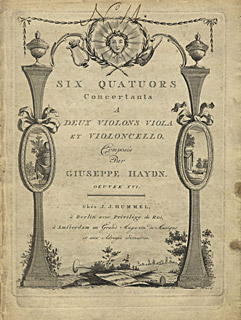
The cover of Haydn’s Op. 20 that gave the “Sun” quartets their name
Haydn’s last movement is a short, action-packed fugue. A fugue is a musical texture in which a single melody is exchanged across a number of voices, creating the impression of a musical tapestry in which a single melody reappears like a bit of bright thread. The theme of Haydn’s fugue is a humorous, slinking tune, consisting of two quick repeated notes followed by an eyebrow-raising dissonance (15:56). There’s a notable incongruity between the levity of the theme and the deeply learned technique of the fugue, making the entire movement another one of Haydn’s jokes. Most of the fugue is played sotto voce (under the voice). Only at the end does the quartet play at full volume, with a forceful and triumphant display of counterpoint (18:32). The conclusion loses none of its earnestness for the comedy that precedes it. Indeed, Haydn’s point seems to be that humor is something worth celebrating. Seamlessly fusing intricate musical technique, cheeky humor, and deep passion, this movement is quintessential Haydn, beautifully concluding his incredibly rich quartet.
Wolfgang Amadeus Mozart (1756-1791)
String Quartet Op. 18, No. 1, “Violet,” K. 575 (1789)
Performance time: 24’
In 1789, Mozart’s life was, to put it bluntly, in shambles. His wife Constanze was chronically sick, and their finances were desperate. A letter requesting money from a friend shows Mozart’s distraught mood:
“Dearest and best friend! / And Most Honorable Brother. / Oh, God! The situation I’m in, I wouldn’t wish it on my worst enemy; and if you, my best friend and brother, forsake me, I, helpless and blameless as I am, will be lost together with my poor, sick wife and child.—I had wished to pour out my heart to you last time I was at your house—but I didn’t have the heart to do it! And I would not have the courage even now—indeed, I can do it only with a trembling hand in writing—and I wouldn’t even dare to put it in writing—if I didn’t know that you know me well, know about my circumstances, and are completely convinced of my innocence in this wretched and most distressing situation. Oh, God! Instead of thanking you, I come to you with new requests!—Instead of paying off my debts, I come asking for more. […] In the meantime I’m composing six easy piano sonatas for Princess Friederike and six quartets for the King…”
Mozart completed only three of these six commissioned quartets. They were to be his last, and are known collectively as the “Prussian” quartets for their dedication to King Friedrich Willhelm II. Fortunately, perhaps, none of Mozart’s personal desperation made it into the first of these quartets, K. 575, which maintains a tranquil mode throughout its duration. There is, however, one circumstance that left a notable imprint on the music: the Prussian King was a cellist. K. 575 in particular, features an exceptionally prominent cello part, giving the King pride of place in the musical drama.
Among composers of his stature, Mozart excels particularly as a melodist, and his quartet proliferates with graceful, singable themes. The first movement’s main theme initially appears as a trio for the three higher strings—the cello sits out, as if the other instruments were laying down a carpet for the royal player. At the end of the exposition (first part of the movement), this same melody reappears, barely altered, but somehow distinctly valedictory in its new context (1:41). The development (central section of the movement) sees the music wander to distant keys and new themes while losing none of its lyricism, before a full reprise of the opening.
Suggested recording: Alban Berg Quartet, 1975
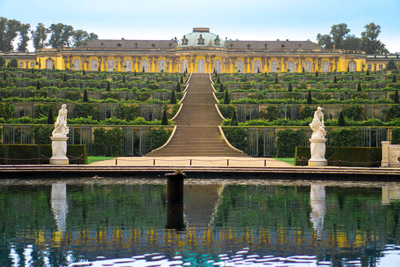
Sanssouci Palace in Potsdam, Germany, Friedrich Willhelm II’s summer residence
The opening of Mozart’s slow movement closely resembles a song he had written several years before, “Das Veilchen” (“The Violet”), about a hopeful but ill-fated flower trampled beneath the foot of the girl it loves. The phrase “Shrinking violet” is an apt description for the music’s texture, which proceeds with bashful, hesitant steps (7:16). This halting pace makes for a beautiful contrast with Mozart’s second theme, where the quartet’s instruments slowly exchange a long, legato melody (8:20). The effect is of the introverted music suddenly opening up to the listener and divulging its essence.
Mozart’s minuet is unusual for the composer. Rather than his typical songful melodies, here, insistent chords presage the blunter style of Beethoven (11:47). The center of the minuet takes the highlighting of the cello to an extreme with a long solo for the instrument (14:29). There is a playful irony here in that the minuet is often a nod to folk music and rural styles (recall the corresponding movement of Haydn). The king dons a peasant dress in a provocative play of class, suggesting, perhaps, his reach in his realm.
Mozart’s finale returns the quartet to its prevailing tuneful character, with a long melody (introduced, of course, by the cello) that recalls the first movement in its expansive breadth (17:34). This last movement is full of gentle humor. A stately violin melody is interrupted by brash neighing in the cello (18:00). Later, two graceful lilting notes from the theme are taken out of context to become an unlikely accompaniment for the melody (21:40). The quartet ends with touching simplicity, with runs up and down the scale in the first violin (23:18). Mozart brings the quartet’s graceful lyricism to its culmination in this last moment, and this simplest musical gesture seems to encapsulate its deep sense of ease.
Felix Mendelssohn (1809-1847)
Capriccio in E minor Op. 81, No. 3 (1843)
Performance time: 7’
Mendelssohn’s “Capriccio” for string quartet is a standalone work, posthumously published after his early death as a set of four pieces. Like Haydn’s capriccio, Mendelssohn’s work follows no preexisting form, though it evokes two styles that are particularly characteristic of his musical interests: the “song without words” and the fugue.
Suggested recording: Brigitte Krömmelbein, violin; Adrian Bleyer, violin; Katharina Arnold, Viola; Sebastian Engelhardt, violoncello, 2020
The first section of the capriccio recalls Mendelssohn’s volumes of “songs without words” for piano, sharing their dark lyricism and tone of dignified nostalgia. The “song” appears in the first violin, mirrored underneath by the cello. The second violin and viola provide a rocking accompaniment in between the two. The texture, with the accompaniment embraced between the lowest and highest voices, evokes intimate space and quiet disclosure.
After a brief, fantasia-like solo for the first violin, Mendelssohn begins his fugue (1:38). The fugue is one of the most thrilling passages Mendelssohn ever composed. Its melody consists of two rapid runs up and down the scale, followed by a driving, ascending figure (1:54). The sense of forward motion seems unstoppable as the instruments each take up this theme, building a texture at once dark and energetic, like a carriage dashing through the night. At the end, fragments of the theme ricochet across the ensemble, creating an atmosphere of seething tension (5:22). Mendelssohn’s conclusion lets the eerie tension of this piece linger tantalizingly, as three decisive chords bring the piece to a forceful end without fully resolving the suspense his music has created.
—Program Notes by Demetrius Shahmehri
With thanks to Floyd and Margaret Grave, Jan Swafford, and R. Larry Todd
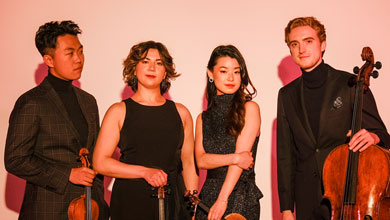
Viano Quartet
Subscribe
Today!
Individual tickets may be purchased at the door (cash or check only) immediately before each concert.
All concerts are held at a private club just off Michigan Avenue in Chicago.
Call or email for more information
815-314-0681
office@ChicagoChamberMusicSociety.org