Program
Shostakovich
Piano Trio No. 1 in C minor, Op. 8
Martinů
Piano Trio No. 2 in D minor, H 327
Dvořák
Piano Trio No. 4 in E minor, Op. 90, “Dumky”
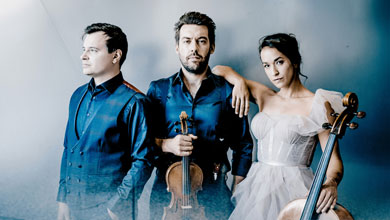
Trio Bohémo
Trio Bohémo is an award-winning Czech chamber ensemble known for their dynamic performances and mastery of the piano trio repertoire. They will be performing Dvořák, a composer close to their hearts.
Program Notes
Dmitri Shostakovich (1906-1975)
Piano Trio No. 1 in C minor, Op. 8 (1923)
Performance time: 14’
In 1923, Shostakovich was a prodigious student at Soviet Russia’s prestigious Petrograd Conservatory in Saint Petersburg. His studies took a pause in 1923 when the young composer contracted tuberculosis, and was sent south to Gaspra, on the Crimean Peninsula, to recover. Shostakovich’s foremost supporter at the conservatory, its director Alexander Glazunov, wrote personally to the Soviet state to sponsor Shostakovich’s trip. Glazunov’s intercession was successful, and things appear to have gone well for Dmitri. His sister, who accompanied him to Crimea, reported dutifully to their mother: “(Dmitri) has grown, got a suntan, is cheerful and has fallen in love.” The girl’s name was Tatyana Glivenko, and Shostakovich dedicated this youthful trio to her. Shostakovich would maintain correspondence with and interest in Glivenko for the next decade, ending only with her marriage and the birth of her first son in 1932.
Suggested recording: Ioana Cristina Goicea, Violin; Astrig Siranossian, cello; Irina Zahharenko, piano, recorded 2021.

Swallow’s nest” castle in Gaspra, on the Crimean Peninsula (this castle was ten years old when Shostakovich visited in 1923)
Shostakovich’s brief, one-movement trio offers a fascinating window into the youth of one of the twentieth century’s most prominent composers. The music opens with a slow, expressive theme in the strings, whose leaps express yearning. A jerky, percussive theme in the piano offers sudden contrast (1:21 in the video. One of Shostakovich’s less sympathetic instructors decried this moment as “grotesque”). The trio’s most important moment comes at its heart: the cello, high in its register, plays a deeply sentimental theme, over a stream of gentle, placid chords in the piano (4:56). This melody, with its charming transparency, is a theme of love from the infatuated teenager. The piece ends with a fortissississimo (yes) rendition of this love theme (13:11).
While one might smile at some of Shostakovich’s more earnest moments here, the trio is remarkable for how its language—its unexpected harmonic turns, dark textures, and blend of sadness and humor—is very much the one this sixteen-year-old would maintain into his mature compositional career.
Bohuslav Martinů (1890-1959)
Piano Trio No. 2 in D minor (1950)
Performance time: 15’
Bohuslav Martinů was one of his century’s great talents, especially remarkable for the vast volume and versatility of his creativity. Martinů emigrated to the United States during World War II, and experienced relative success: as a Czech expatriate, he was celebrated as the leading musical representative of an American wartime ally, achieving particular success with a string of six dense and otherworldly symphonies. This second piano trio was composed for one of his many commissions, the opening of the Hayden Library at MIT. One biographer suggests there may be a subtle musical pun. This second piano trio mimics the style of Haydn, one of the piano trio’s greatest practitioners. Martinů has stripped away at his typically busy instrumental style to create a lucid, transparent, and immediately inviting musical world.
Suggested recording: Jan Fišer, violin; Michal Kaňka, cello; Stanislav Gallin, piano, recorded 2020.
MIT’s Hayden Memorial Library in the 1950’s, where Martinů’s Trio was first performed
The main theme of Martinů’s first movement is a graceful, lilting violin melody that sweeps skyward, while a moodier second theme draws the music sternly down (0:43 in the video). Martinů’s music, in keeping with his classical aesthetic, is emotionally restrained, but creates a forceful climax at the center of the movement, with motoric rhythmic figures in the cello and piano and suspensefully rising lines in the violin (1:57). After a brief reprise of Martinů’s opening material, the conclusion seems to tap into a hidden reserve of energy, ending with a frantic, joyous sprint (4:20). The rest of the piece will aim to recapture this jubilant mood.
The clear, airy sound of Martinů’s second movement comes from the violin and piano playing in unison. A lullaby-like melody unfolds with a slow, tender lyricism, and violin and piano move in lockstep as if clasping hands (5:32). Late in the movement, softly pattering four-note phrases meander throughout the trio, dreamily recalling accompaniment figures of Haydn and Mozart (9:12). Martinů ends with a haunting, fragmented version of the lullaby theme, which slowly dissipates on the violin (10:12).
Martinů’s final movement is an all-out dash. The strings saw away rapidly, sharp dissonances in the piano cloud the texture, phrases ricochet between the instruments, sudden stops only add to the tension. A brief variation or memory of the rising theme of the first movement brings some rest (13:00). As in that movement, though, the trio’s conclusion pushes the music to newly energetic heights, and the trio ends with riotous joy and almost comic exuberance.
Antonín Dvořák (1841–1904)
Piano Trio No. 4 in E minor, Op. 90 (Dumky, 1891)
Performance time: 30’
“At the moment I’m working on something very small,” the Czech composer Dvořák wrote to a friend in 1890. “These are little pieces for violin, cello, and piano.” These “little pieces” would become one of Dvořák’s grandest and most unusual works, a piano trio built not from traditional classical structures, but from a series of dumky, a musical form adapted from Slavic folk music. Dumka simply means “thought” in Ukrainian, but Dvořák and other composers associated it with a piece that would shift abruptly between emotional extremes. Rather than the traditional three or four movements in related keys, Dvořák’s trio consists of six short dumky, often folklike in character and almost always including great alternations in mood. Uniting the trio is Dvořák’s characteristic (and very Czech) lyricism, though in a paradoxical way, contrast itself becomes a unifying theme in the Dumky Trio.
Suggested recording: Tim Brackman, violin; Kalle de Bie, cello; Rik Kuppen, piano, recorded 2020
Dvořák’s first movement is so lovely that it can be easy to miss just how unusual it is. Rather than beginning with a traditional long movement in a three-part sonata form, Dvořák’s conceit is a short structure that simply alternates two contrasting episodes. A rising cello line begins the first section with a bold, sweeping gesture, drawing the music into a subdued, hazy world. But the music veers off suddenly into a brisk, chipper folk dance, with a scampering part for violin and piano (1:35 in the video). The extreme contrast between these sections is characteristic of the dumka and sets the pattern the rest of the trio will follow.
The brevity of the first movement places an unusual weight on the second. This movement bears a particular debt to Schubert, recalling the Austrian composer’s songs in its slowly unfolding harmonies, repetitive accompaniment, and lyrical melody in the cello (3:57). There is a deeply touching simplicity in this music, in which every note is given weight and value. But this movement, too, is a dumka: Dvořák alternates statements of the lengthy songlike theme with a faster passage whose dissonant grace notes give it an impish character (6:20). This faster theme brings the otherwise subdued movement to an energetic close.
One way of hearing the movements that follow is as a gradual acceleration from the slow tempo of the second. The widely-spaced harmonies and spare textures of the third movement give the music a breathtaking spaciousness (10:34). A wistful, unaccompanied melody on the piano is especially striking, like a tune sung offhandedly on a plain (10:58). After a vivacious folk-dance interlude, the violin’s soft rendition of this melody over droning piano chords are more evocative than ever of folk music (14:45).
The pace of the fourth movement quickens only slightly with a funeral march. Plodding chords in the piano and an obstinate four-note accompaniment in the violin set the backdrop for a plaintive cello melody (16:24). This dumka contains two contrasting episodes: the second is especially remarkable for its emulation of the accelerating tempos common throughout Eastern-European folk dances (19:00). Dvořák’s conclusion to this movement is especially touching: the violin’s accompaniment to the funeral march is transformed into high, gentle piano chords, ringing against a rumble in the bass (20:38). The chords are distinctly evocative of church bells, and the funeral march is transformed into a wedding heard in the distance.
The contrasts in the fifth dumka movement are slighter. The first section introduces a songful melody in a highly flexible tempo (21:32), while the second is a contrapuntal passage where violin and cello frantically chase each other’s melodies (22:15). Dvořák’s sixth and final dumka offers the trio’s most intense music. Its main theme harps obsessively on two repeated notes, turning into a thunderous stomping dance on the piano (26:25). Dvořák contrasts this with a passionate, lyrical theme in the violin (27:16), at the end, an exquisite soaring line in the cello (29:20).
Dvořák faces a compositional challenge in this last movement: how do you conclude a piece whose essence consists of extreme contrasts? Dvořák settles on an emotionally neutral and decisive gesture, rapidly concluding his utterly unique piano trio with a display of sheer musical force.
—Program Notes by Demetrius Shahmehri
With thanks to Laurel Fay, Brian Large, and Michael Beckerman
Trio Bohémo
Subscribe
Today!
Individual tickets may be purchased at the door (cash or check only) immediately before each concert.
All concerts are held at a private club just off Michigan Avenue in Chicago.
Call or email for more information
815-314-0681
office@ChicagoChamberMusicSociety.org